
Technical Guides
Cam Lock Insert Types: Complete Cylinder Lock Key Selection Guide
What Is a Cam Lock Insert?
A cam lock insert (also called the cylinder lock key type or “lock insert”) is the removable drive element mounted on the front of a cam lock barrel. It is the part you actually turn with a key, driver, or finger to rotate the cam and lock or unlock a cabinet door. The insert is what determines which tool can operate the lock — and therefore how secure or how convenient it is.
Choosing the right insert is the most commonly overlooked step in cylinder lock selection. Buyers typically focus on body material, length and finish, but the insert shape alone decides three things at once: tool compatibility (what key you must stock), security level (how hard it is for an unauthorized person to open), and user convenience (can it be opened with a coin, a screwdriver, or only a dedicated tool).
This guide explains all 18 insert types available on the Reaking MY705 series, groups them by drive family, and gives a practical selection table so you can pick the right cylinder lock key type for your application.
18 Cam Lock Insert Types Explained
Cam lock inserts fall into six families, from the least secure (tool-free or coin-operated) to high-security specialty drives. Below is each type with the tool it needs and where it is typically used.
Wing / Double-Bit Drives
Wing inserts (also called “butterfly” or “double-bit”) are the most common, lowest-cost drive. They are operated with a simple wing key or, in a pinch, a pair of pliers. Security is minimal — they are meant to keep doors shut, not to prevent access.
- 1A — Double-bit 4 mm pin: standard general-purpose wing drive for telecom and office cabinets.
- 10 — Thorn (double-wing): a reinforced double-wing profile for frequent daily operation.
- 11 — Double-bit 3 mm pin: a smaller wing drive for compact cabinets, file cabinets and furniture.
Triangular Drives
Triangular inserts require a dedicated triangular key or socket. They stop casual tampering and are the default choice for utility and public-facing enclosures where a flat-blade screwdriver should not work.
- Triangular 7 mm: common on utility cabinets and access panels.
- 12 — Triangular 8 mm: the most widely specified triangular size for electrical panels.
- 13 — Triangular 9 mm: for larger panels and distribution boards.
- 15 — Triangular 10 mm with center pin: adds a center pin so only a matching hollow triangular key fits — a step up in tamper resistance, used on utility meters and anti-tamper enclosures.
Square Drives
Square inserts use a square drive key and are common in HVAC, machinery and industrial electrical equipment. They resist screwdriver and plier attacks better than wing drives.
- Square 6×6 mm: compact square drive for small enclosures.
- Square 7×7 mm: standard square drive for electrical enclosures.
- Square 8×8 mm: heavy-duty square drive for industrial cabinets.
- Square 8×8 mm slotted: the square drive plus a screwdriver slot, giving two opening options.
Hexagon Socket Drives
Hexagon (Allen-type) inserts are operated with a standard hex key — convenient because hex keys are everywhere in a workshop, but only moderately secure for the same reason.
- 18 — Hexagon socket 8 mm with center pin: a tamper-resistant hex with a center pin so only a hollow hex key works.
- Hexagon socket 10 mm: large hex drive for industrial equipment and heavy doors.
Slotted Drives
Slotted inserts are the least secure — openable with a flat-blade screwdriver or even a coin. They suit low-security, convenience-first applications.
- Slot (single slot): standard slotted drive for low-security cabinet doors.
- 16 — Concave slotted: a recessed concave slot that guides the driver and looks cleaner on flush panels.
Specialty Drives
Specialty profiles are chosen for higher security or for an unusual tool footprint, making unauthorized opening genuinely difficult.
- 14 — Heptagon (7-sided): an uncommon seven-sided drive requiring a dedicated key — strong tamper resistance for security enclosures.
- Hooked (S-shape) 4 mm: an S-shaped profile that needs a matching hooked key — used on anti-tamper and restricted-access panels.
- Flat cylinder (oval): a low-profile oval drive used where a flush, tool-specific design is required.
Cam Lock Insert Selection Table
Use this table to shortlist the right insert for your security and tooling requirements.
| Insert Type | Tool Required | Security Level | Typical Use |
|---|---|---|---|
| 1A Wing 4 mm | Wing key / pliers | Low | Telecom, office cabinets |
| 10 Double-wing | Wing key | Low | General purpose |
| 11 Wing 3 mm | Wing key / pliers | Low | File & furniture cabinets |
| Triangular 7 mm | Triangular key 7 mm | Medium | Utility cabinets, access panels |
| 12 Triangular 8 mm | Triangular key 8 mm | Medium | Electrical panels |
| 13 Triangular 9 mm | Triangular key 9 mm | Medium | Distribution boards |
| 15 Triangular 10 mm + pin | Hollow triangular key | Medium-High | Meters, anti-tamper enclosures |
| Square 6×6 mm | Square key 6 mm | Medium | Compact enclosures |
| Square 7×7 mm | Square key 7 mm | Medium | Electrical enclosures |
| Square 8×8 mm | Square key 8 mm | Medium | Industrial cabinets |
| Square 8×8 mm slotted | Square key / driver | Medium | HVAC, electrical |
| 18 Hex socket 8 mm + pin | Hollow hex key 8 mm | Medium | Machinery, tamper-resistant |
| Hex socket 10 mm | Hex key 10 mm | Medium | Industrial equipment |
| Slot (single slot) | Flat driver / coin | Low | Low-security doors |
| 16 Concave slotted | Flat driver | Low | Flush-panel cabinets |
| 14 Heptagon | Heptagon key | High | Security enclosures |
| Hooked (S-shape) 4 mm | Hooked key | High | Restricted-access panels |
| Flat cylinder (oval) | Oval key | Medium-High | Specialty, flush design |
Cylinder Lock Anatomy: The Parts Around the Insert
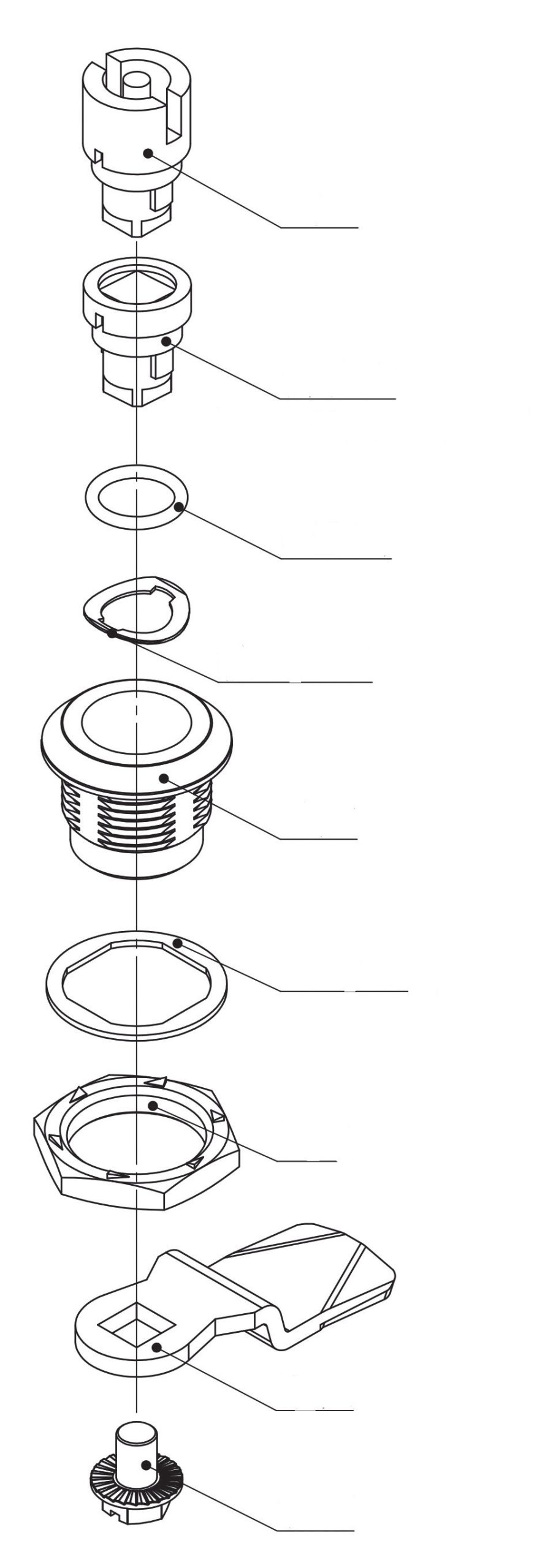
An insert never works alone. Understanding the full cylinder lock assembly helps you specify a complete, correct part. The standard exploded-view construction of a cam lock is:
- Insert — the drive element covered above.
- Shaft — the threaded barrel that passes through the panel and carries the cam; its length is specified as the GH (grip / housing length).
- Wave washer — a spring washer that keeps tension on the assembly and prevents rattling.
- Housing — the lock body (zinc alloy, stainless steel or PA nylon).
- Seal — a gasket that contributes to the IP rating (e.g. IP54) on sealed versions.
- O-ring — a rubber ring that seals the insert to the housing on sealed versions.
- Nut — the mounting nut (often an 11 mm external hexagon) that clamps the lock to the panel.
- Cam — the rotating latch arm that actually engages the frame; available in straight, offset and hook profiles.
- Screw — fastens the cam to the shaft end.
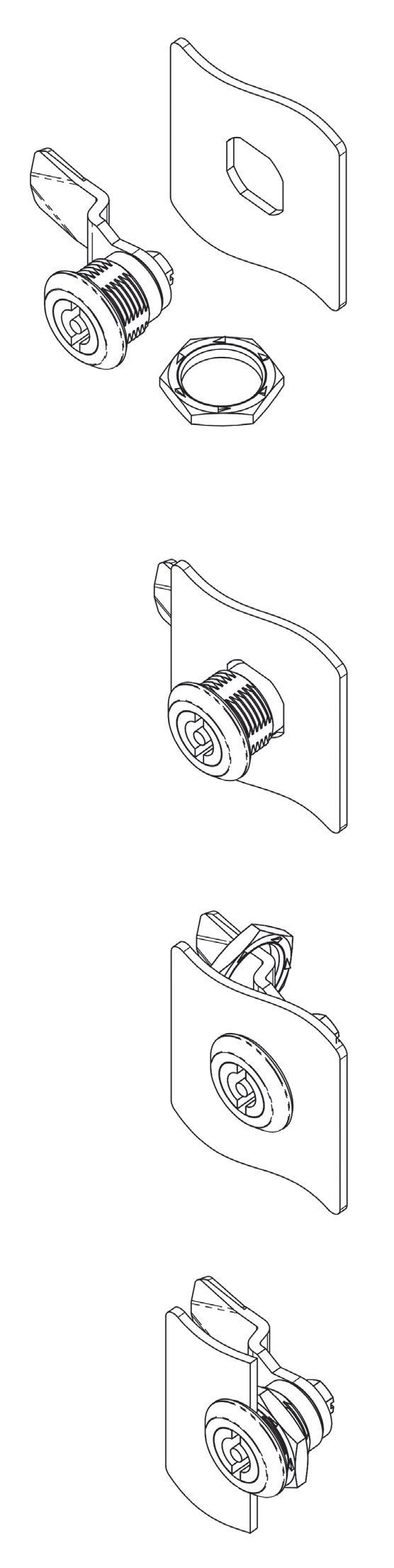
When specifying, always give the GH length (the panel thickness range it must span) together with the insert type — the two together define the physical lock.
Other Cylinder Lock Selection Factors
The insert is one of six decisions. The others, in order of importance:
- Body material — zinc alloy (general indoor), SUS304/SUS316 stainless steel (outdoor, coastal, corrosive), or PA nylon (lightweight, non-conductive).
- GH length — must match your door + frame thickness; common GH values are 18, 28, 36, 42 and 62 mm.
- Key system — keyed-alike, master-keyed, or individually keyed (e.g. CH751, K15-1, K333 series).
- IP rating — IP54 or higher for outdoor and washdown environments.
- Rotation angle — 90°, 180° or 270° depending on whether the cam must swing clear of the frame.
How to Choose: Application Scenarios
Telecom / network cabinets (indoor, low security): a wing or slotted insert keeps doors shut and is the cheapest to maintain. Pair with a zinc alloy body and a standard GH length.
Electrical distribution boards (public access, medium security): a triangular 8 mm or square drive prevents casual opening with a screwdriver. Choose IP54 sealing if installed where dust or moisture is present.
Utility meters and anti-tamper enclosures (higher security): a triangular 10 mm with center pin, a hex socket with center pin, or a heptagon drive requires a dedicated tool, deterring unauthorized access.
Outdoor / coastal / washdown enclosures: combine a stainless steel body (SUS316 for coastal) with a tamper-resistant insert and an IP54 or IP65 rating. For more on this, see our guide to choosing cabinet locks for outdoor enclosures.
Frequently Asked Questions
What is the difference between a cam lock insert and the cam lock key?
The insert is the drive element built into the front of the lock barrel; the key is the separate tool that mates with that insert. For tool-operated types (triangular, square, hexagon), you stock one key per insert profile. For wing types, a generic wing key opens them.
Which cam lock insert is the most secure?
The specialty profiles are the hardest to open without the right tool: heptagon (7-sided), hooked (S-shape), and the center-pin triangular and hexagon sockets. The center-pin versions defeat ordinary solid keys because they need a matching hollow key.
Can I get multiple cabinets keyed alike?
Yes. Wing, triangular, square and hexagon inserts can all be supplied keyed alike, master-keyed, or individually keyed across a large order, so one key operates every lock in your fleet.
How do I specify the right insert when ordering?
State the insert type (e.g. “triangular 8 mm”), the body material, the GH length, the key system (keyed alike or not), and the required IP rating. Providing all five avoids mismatched parts.
Are these cam locks waterproof?
Sealed versions with a gasket achieve IP54 (protected against dust and splashing water) and are suitable for outdoor and washdown use. For fully sealed, high-pressure applications, choose a compression latch with an IP65 rating — see our IP65 vs IP54 comparison.
About Reaking
Reaking manufactures industrial cabinet hardware in Shengzhou, Zhejiang, China. Our main products include industrial cabinet locks (cylinder locks, panel locks, RV locks, plane locks, rod control locks), handles, hinges and sealing strips. We supply hardware for industrial enclosures, telecom cabinets, data center cabinets, energy storage cabinets and RV applications. We serve buyers across Europe, North America, Middle East and Southeast Asia. OEM and custom orders are welcome.

Pingback: Cam Lock Sizes: 16mm, 19mm & 22mm Selection Guide