Technical Guides
Industrial Cabinet Lock Catalogue: Series, Symbols & Specifications Guide
Nine Product Series at a Glance
Reaking manufactures nine families of industrial cabinet hardware, each covering a specific locking or motion-control function. Understanding this structure is the fastest way to navigate the catalogue and find the right part.
| Series | Code | Typical Function |
|---|---|---|
| Cylinder Lock | A | Key-operated rotary latch for general cabinet doors |
| Handle Lock | B | Ergonomic L/T-handle quarter-turn lock with sealing |
| Plane Lock | C | Flush quarter-turn and swing-handle panel locks |
| Rod Control Lock | D | Multi-point locking via vertical rods for tall doors |
| Panel Lock | E | Recessed paddle / push-to-close panel latches |
| Toggle & Hook | F | Compression toggle latches and draw latches |
| Door Stop | G | Friction stays and travel limiters for cabinet doors |
| Handle | H | Pull handles and grip handles |
| Hinge | J | Continuous, butt, concealed and lift-off hinges |
How to Read the Catalogue Symbols
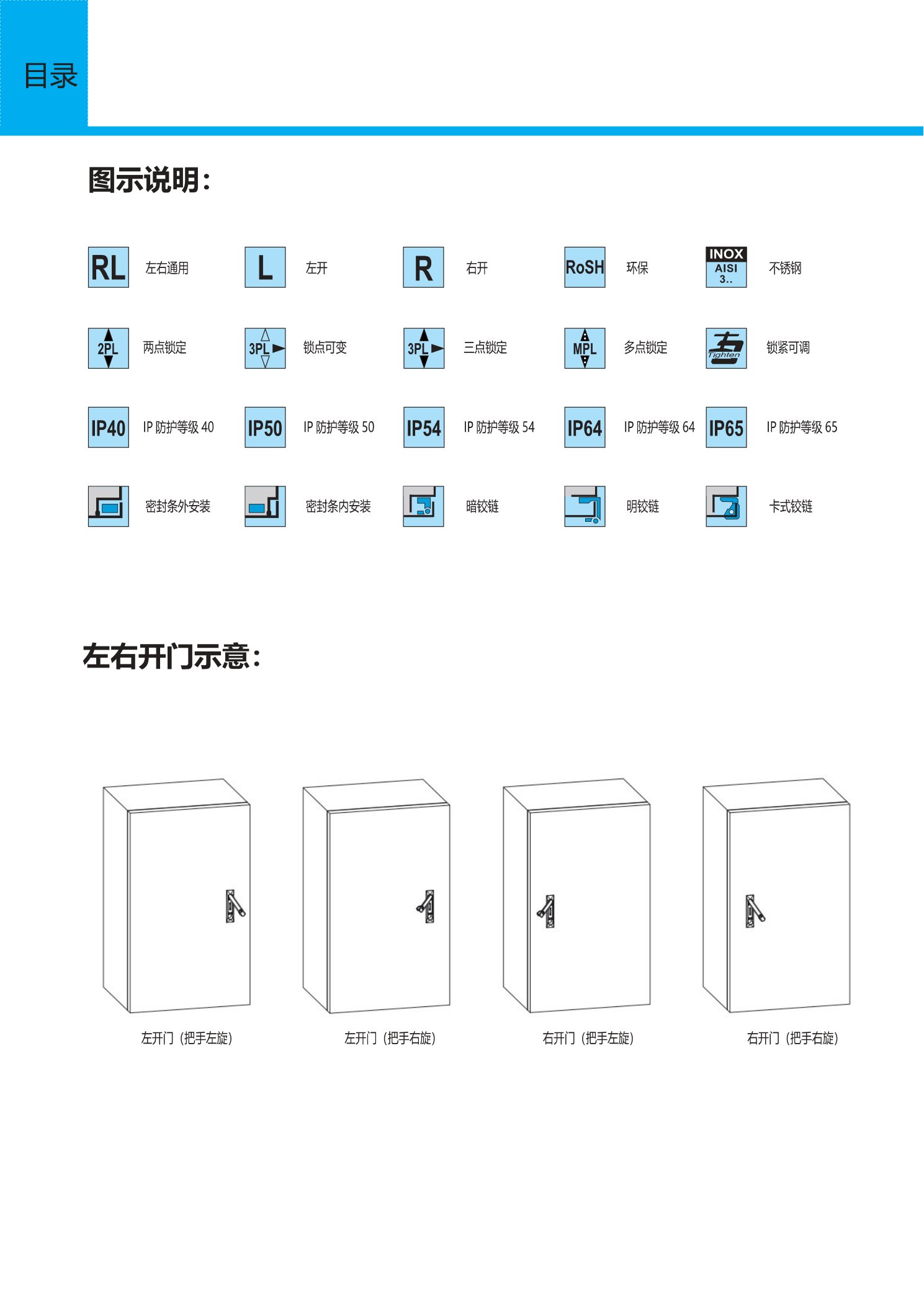
Every Reaking catalogue page carries a set of pictograms that summarise a part’s key attributes at a glance. Before you read any product page, learn these symbols — they answer the four questions buyers ask first: which way does it open, how does it lock, how sealed is it, and how does it mount?
- Opening direction — left/right reversible, left opening, or right opening. The pictograms show the door swing and handle rotation direction.
- Locking type — 2-point, 3-point, multi-point locking, adjustable locking point, and adjustable latch. These tell you how many rods or cams engage the frame.
- Ingress protection — IP40, IP50, IP54, IP64 and IP65. The first digit is dust protection, the second is water protection. See our IP65 vs IP54 guide for details.
- Material & compliance — the stainless steel mark (AISI 304/316) and the RoHS environmental mark.
- Seal & hinge mounting — seal inside / outside installation, and clip-on, concealed or exposed hinge types.
Key Dimensions: GH, TS and Stop Height
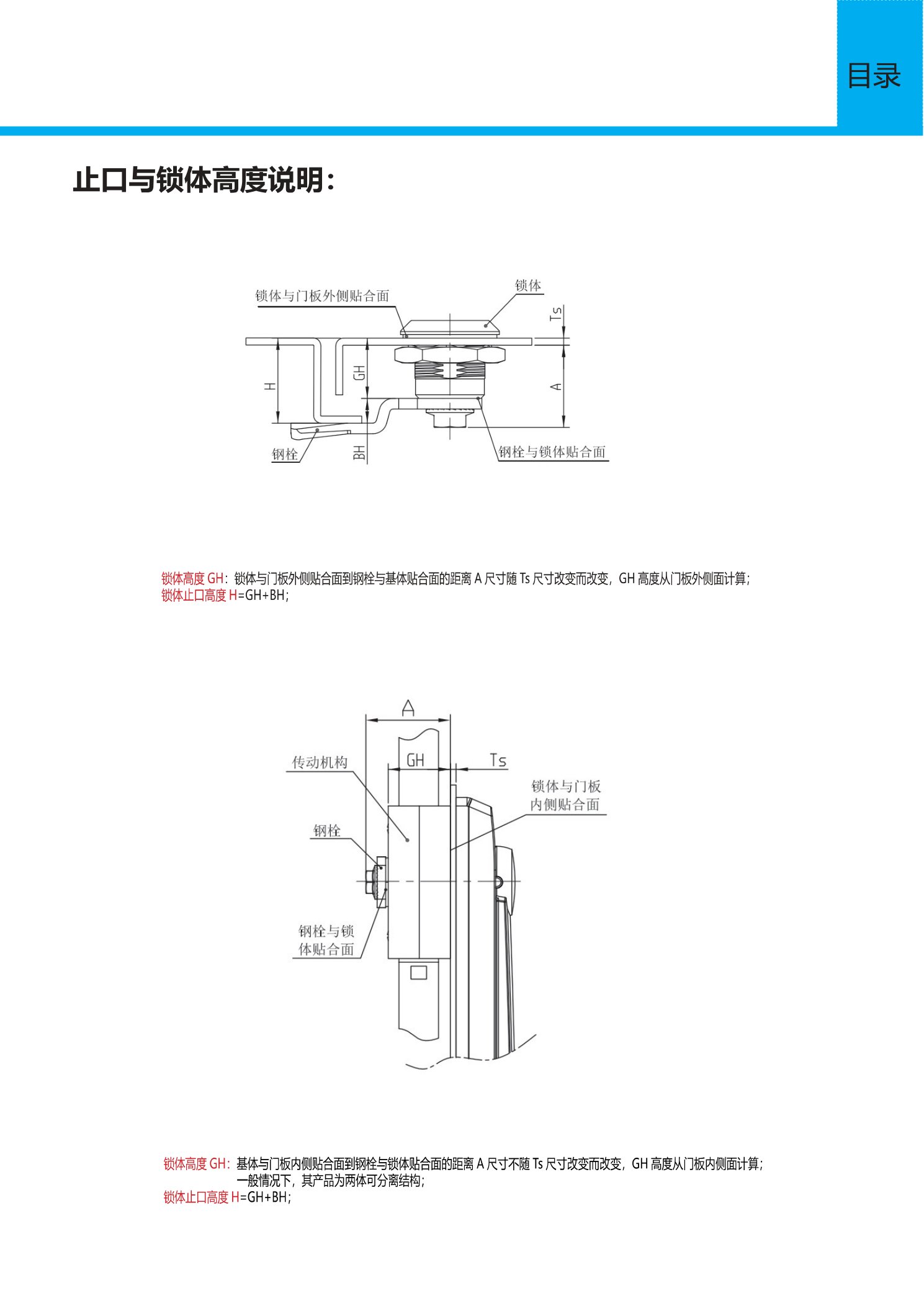
Three dimensions determine whether a lock fits your enclosure. Getting them right avoids the most common ordering mistake — a lock that is too short or too long for the panel.
- GH (lock body height) — the distance from the lock body’s outer seating face to the face where the steel bolt/keeper meets the base, measured from the outside of the door panel. It must span your panel thickness.
- TS (panel thickness) — the door panel thickness the lock is designed for.
- Stop height H — the total rebate height, calculated as H = GH + BH.
The transmission mechanism and the steel bolt (locking rod) sit behind the body. In the common two-piece design, the body and the bolt assembly separate so the lock can be fitted through a standard mounting hole.
Rod Lock Installation and Length Calculation
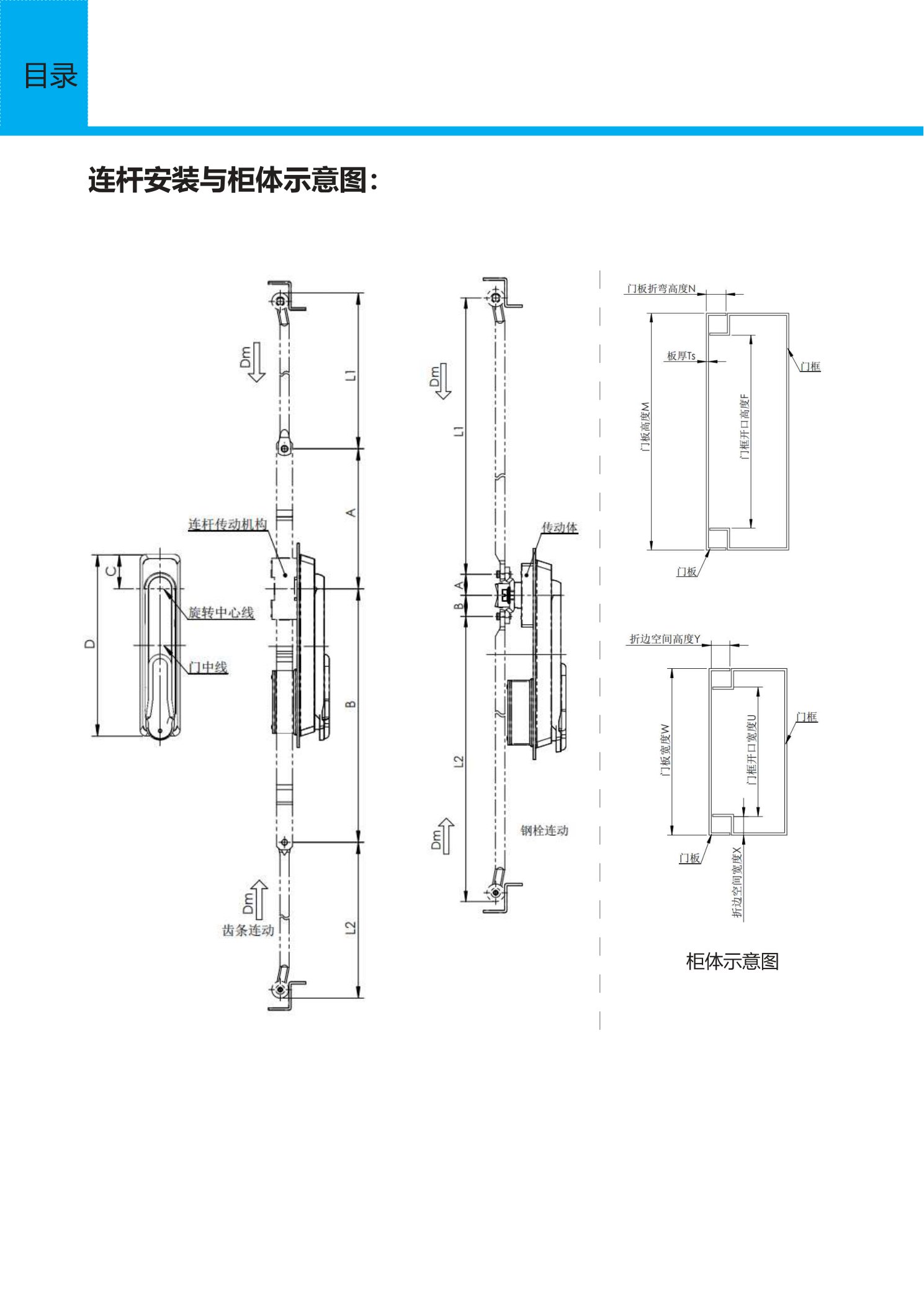
For rod control locks on tall cabinets, the vertical rods must be cut to the exact length so the locking points land in the right position. Reaking’s catalogue gives the calculation directly.
- F — door frame opening height
- M — door panel height
- N — door panel bend height
- TS — panel thickness
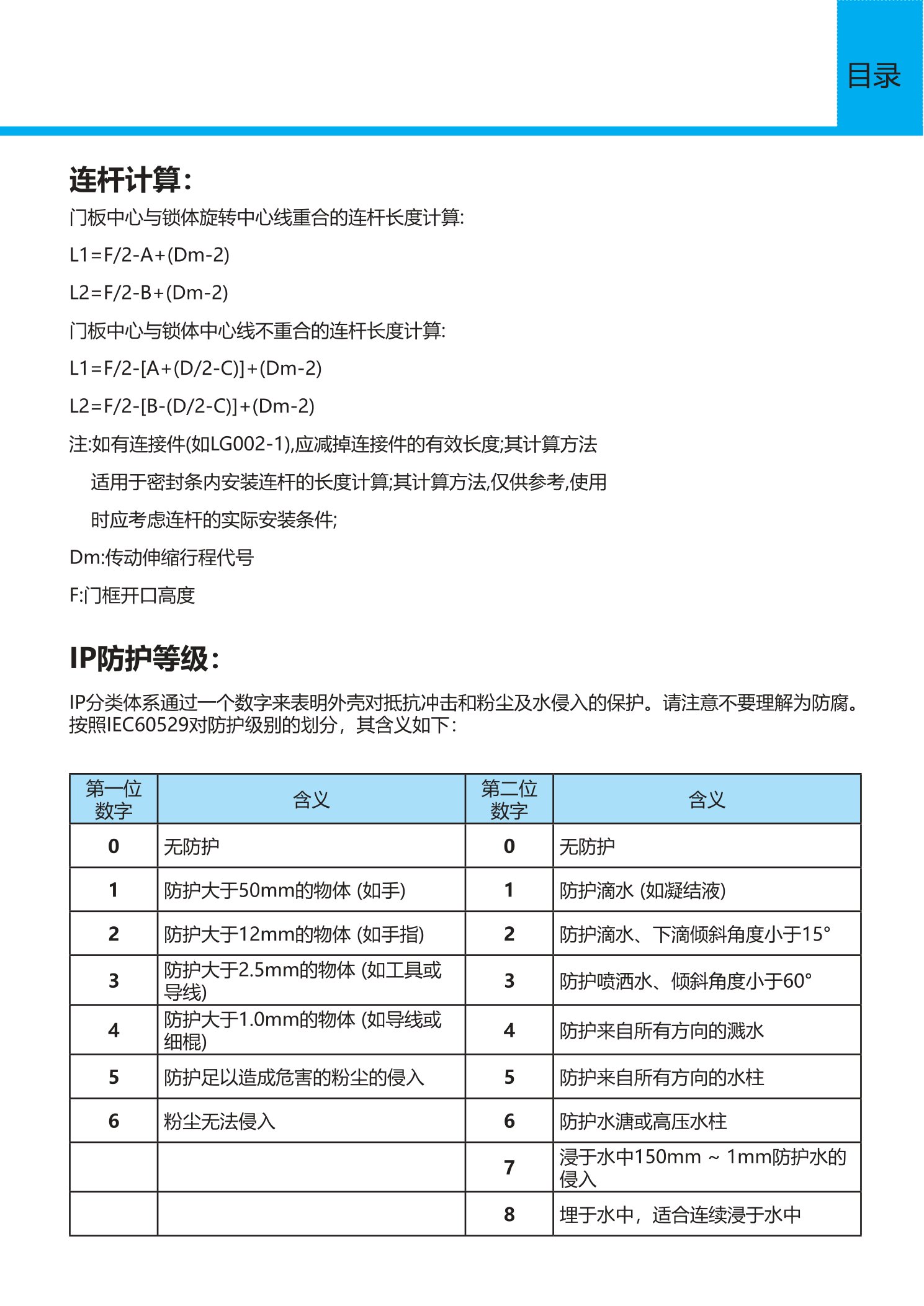
When the door centre line and the lock rotation centre line coincide, the rod lengths are:
- L1 = F/2 − A + (Dm − 2)
- L2 = F/2 − B + (Dm − 2)
When the two centre lines do not coincide, the corrected formulas are:
- L1 = F/2 − [A + (D/2 − C)] + (Dm − 2)
- L2 = F/2 − [B − (D/2 − C)] + (Dm − 2)
Part Number and Material Codes
Every finished part carries a structured code that fully describes it, so you can order precisely without ambiguity. A typical number looks like MY705-1-Z21-1:
- MY — series/category code (here, cylinder lock)
- 705-1 — main type and sub-type (the specific lock model)
- Z21 — surface finish code (e.g. bright chrome)
- -1 — material code (e.g. zinc alloy)
The catalogue lists the full surface-finish and material code tables so you can decode any part number. Always quote the complete code when requesting a quote to guarantee you receive the exact configuration.
Locking Rods, Keepers and Accessories
Rod-control and multi-point locks rely on a family of steel bolts (rods) and keepers. These are coded separately so the right length and bend height can be selected:
- S-series steel bolts — straight and bent rods (e.g. S1B45xx, S2, S3) with a coded bend height, used for single-point and multi-point rod systems.
- LG / RG guide rods — rod guides and connecting rods with configurable length (e.g. LG001, RG001 series).
Because rods are cut to length per door height, always provide the door height (F/M) and locking-point position when ordering.
Frequently Asked Questions
What does GH mean on a cabinet lock?
GH is the lock body height — the distance from the outer seating face to the bolt-to-body contact face, measured from the outside of the panel. It must match your panel thickness (TS).
How do I calculate the rod length for a rod control lock?
Use L1 = F/2 − A + (Dm − 2) and L2 = F/2 − B + (Dm − 2) when the door and lock centre lines coincide; add the offset correction (D/2 − C) when they do not. F is the door frame opening height.
What is the difference between IP54 and IP65?
IP54 is protected against dust and splashing water; IP65 is fully dust-tight and protected against water jets. Choose IP65 for washdown and harsh outdoor use. See our full comparison.
How do I decode a Reaking part number?
The code is structured as category + model + surface finish + material — for example MY705-1-Z21-1 = cylinder lock MY705-1, finish Z21, material 1. Quote the full code to guarantee the exact build.
Can I get a left and a right opening version of the same lock?
Many Reaking locks are left/right reversible. Where a specific direction is required, the catalogue symbol marks left-opening or right-opening variants so you can order the correct hand.
About Reaking
Reaking manufactures industrial cabinet hardware in Shengzhou, Zhejiang, China. Our main products include industrial cabinet locks (cylinder locks, panel locks, RV locks, plane locks, rod control locks), handles, hinges and sealing strips. We supply hardware for industrial enclosures, telecom cabinets, data center cabinets, energy storage cabinets and RV applications. We serve buyers across Europe, North America, Middle East and Southeast Asia. OEM and custom orders are welcome.

Pingback: Rod Control Lock: Bar Drive vs Cam Drive Explained