
Technical Guides
Rod Control Lock Drive Mechanisms: Bar Drive vs Cam Drive Explained
One Rod Control Lock, Two Ways to Drive the Rods
A rod control lock — also called a connecting rod lock or multi-point rod latch — turns one handle or key into multi-point locking. But not every rod control lock transmits that motion the same way. Two control systems dominate the category: bar drive and cam drive. They look similar from the outside, yet the mechanism behind the handle is what decides how smoothly, how firmly, and how reliably a tall cabinet door locks along its full height.
This guide explains both drive systems, how they differ, and how to choose the right one for your enclosure.
What Is a Rod Control Lock?
A rod control lock is a centralized locking mechanism for tall cabinet and enclosure doors. When you turn the handle or key, it does not just throw a single small latch — it drives two metal rods, one upward and one downward, so the door is latched at three points along its edge (top, middle and bottom).
That multi-point engagement is the whole point: it distributes pressure evenly, stops tall doors from bowing or gaping at the corners, and lets an enclosure hold a consistent IP rating across its full height. This is why rod control locks are standard on distribution cabinets, telecom enclosures, data center racks and large machinery housings.
The mechanism that turns the handle’s rotation into the rods’ linear travel is the drive mechanism — and this is where the two control systems differ.
Control System 1 — Bar Drive (Mechanical Rod Transmission)
In a bar drive system, the handle or key drives the rods through a connecting bar (a rigid link arm). The motion path is simple and direct:
- You turn the handle or key.
- The handle’s rotation swings a connecting bar.
- The bar pushes and pulls the top and bottom rods in opposite directions.
- The rods slide into the strikes at the top and bottom of the frame, latching the door at three points.
Bar drive is the classic mechanical transmission approach. Because the bar is a rigid link, the motion is transferred with very little lost travel, which keeps the rods synchronized and the handle feeling direct and firm.
Control System 2 — Cam Drive
In a cam drive system, the handle or key drives the rods through a cam — an eccentric rotating plate — usually housed inside a “rod box” assembly. As the cam rotates, its profile pushes the rods (or a rod plate) linearly.
- You turn the handle or key.
- A cam on the lock spindle rotates through 90° (or more).
- The cam’s eccentric profile drives the rod box assembly.
- The rods travel up and down to latch the door at the top, middle and bottom.
Cam drive is compact and well suited to swing-handle and lift-up handle designs, where the lock body needs to stay slim. The cam profile can also be shaped to give a controlled amount of travel and a self-centering feel as the lock reaches its closed position. A good example is the ML731-3 multi-point rod control lock, whose cam and rod box assembly drive the top and bottom rods.
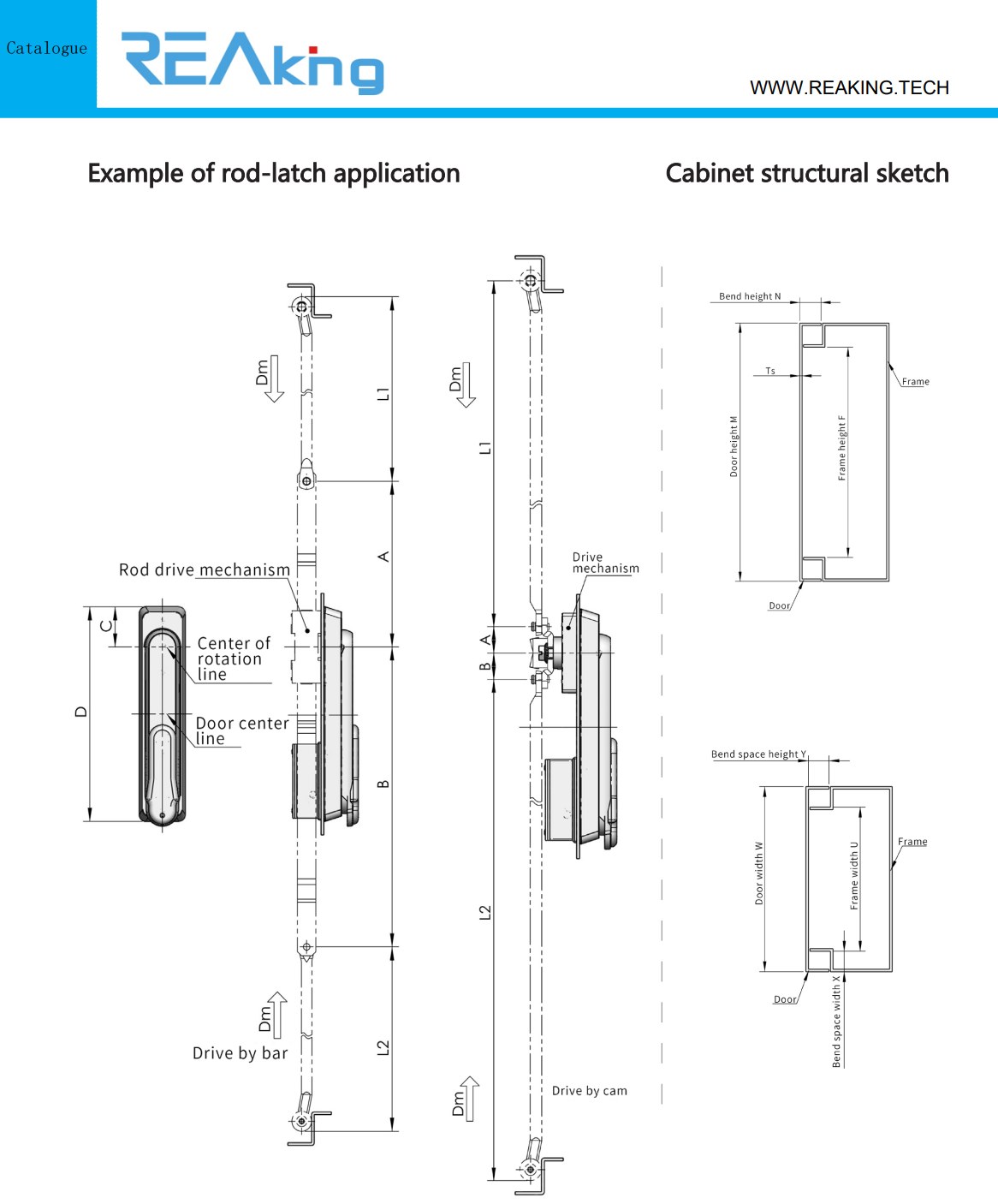
Bar Drive vs Cam Drive: Side by Side
| Feature | Bar Drive | Cam Drive |
|---|---|---|
| How motion is transferred | Rigid connecting bar | Rotating cam + rod box |
| Typical handle style | Lever / handle or key | Swing handle or lift-up handle |
| Feel | Direct, firm | Smooth, self-centering |
| Locking points | 3 (top / middle / bottom) | 3 (top / middle / bottom) |
| Lock-body profile | Good | Excellent (slim body) |
| Best for | Robust, straightforward installations | Slim, swing-handle designs |
How to Choose the Right Drive Mechanism
- Choose bar drive when you want a robust, direct feel and a simple mechanical path with few moving parts.
- Choose cam drive when you need a compact lock body or a swing-handle / lift-up handle design with a smooth, self-centering action.
- Either way, match the rods to your door. Rod length is calculated from the door height so the rods land exactly in the top and bottom strikes. See our rod control lock range for dimension drawings and rod-length formulas, and our catalogue guide for how to read the part numbers and symbols.
Frequently Asked Questions
What is a rod control lock?
A rod control lock is a multi-point cabinet lock that drives top and bottom connecting rods from a single handle or key, latching a tall door at three points along its edge.
What is the difference between bar drive and cam drive?
Bar drive transmits the handle’s motion to the rods through a rigid connecting bar, while cam drive uses a rotating cam (usually inside a rod box assembly). Both deliver three-point locking; they differ in mechanism, feel and lock-body profile.
Why do tall cabinet doors need multi-point locking?
A single-point latch leaves the top and bottom corners free to bow and gap. Multi-point locking spreads pressure along the door edge, keeping the seal even and the door resistant to prying.
How do I size the rods for my door?
Rod length is derived from the door (frame opening) height so the rods engage the top and bottom strikes correctly. Reaking supplies the rod-length formulas and cut-out drawings with each rod control lock.
Are rod control locks weatherproof?
Many Reaking rod control locks are rated IP54 or higher, protecting against dust and splashing water. For outdoor or coastal enclosures, choose stainless steel versions for better corrosion resistance.
About Reaking
Reaking manufactures industrial cabinet hardware in Shengzhou, Zhejiang, China. Our main products include industrial cabinet locks (cylinder locks, panel locks, RV locks, plane locks, rod control locks), handles, hinges and sealing strips. We supply hardware for industrial enclosures, telecom cabinets, data center cabinets, energy storage cabinets and RV applications. We serve buyers across Europe, North America, Middle East and Southeast Asia. OEM and custom orders are welcome.
