
Technical Guides
Steel Core vs Wire Braid Sealing Strip: How to Choose
Steel Core vs Wire Braid: The Carrier Inside Your Sealing Strip
When people pick a sealing strip for a cabinet, enclosure or door, they usually focus on the rubber compound and the profile shape — and overlook the metal carrier hidden inside. The carrier is what actually holds the strip onto the panel edge, and it comes in two main types: steel core and wire braid. This guide explains how they work and how to choose.
What Does the Carrier Inside a Sealing Strip Do?
The rubber skin of a sealing strip (usually EPDM) is soft and flexible, but on its own it cannot grip a sheet-metal edge firmly — over time it loosens and shifts. That is why a metal carrier is embedded inside:
- Clamping — holds the strip firmly onto the door or frame edge;
- Shape retention — keeps the strip straight and stable over long runs;
- Even pressure — distributes sealing force evenly as the door opens and closes.
Our carrier comes in two main types: steel core (steel carrier) and wire braid (wire carrier).
Steel Core Sealing Strip (Steel Carrier)
A steel core strip embeds a continuous stamped steel sheet, produced as a single-bridge or double-bridge profile.
Advantages
- Stronger clamping — the steel core grips better than wire-feed devices;
- Good rigidity — stable shape and even sealing pressure on straight, long edges.
Things to watch
- A continuous steel core has a limited bend radius at the cut edge, so tight corners are harder to form;
- The fix is to remove the continuous bridge at the corner so the strip can bend. The trade-off is slightly uneven strand pressure locally — for most engineering applications the visual impact is negligible.
Typical specifications — steel sheet thickness 1.5 mm or 2.0 mm; sheet spacing must leave room for compression.
Wire Braid Sealing Strip (Wire Carrier)
A wire braid strip embeds a braided steel wire structure, which is more flexible.
Advantages
- Flexible and easy to bend — 90° corners can be formed on site;
- Flexible installation — suits irregular profiles and follow-the-shape mounting.
Things to watch
- Slightly weaker clamping than a steel core (wire-feed type), with a different fixing method;
- Corners must be bent and fitted correctly.
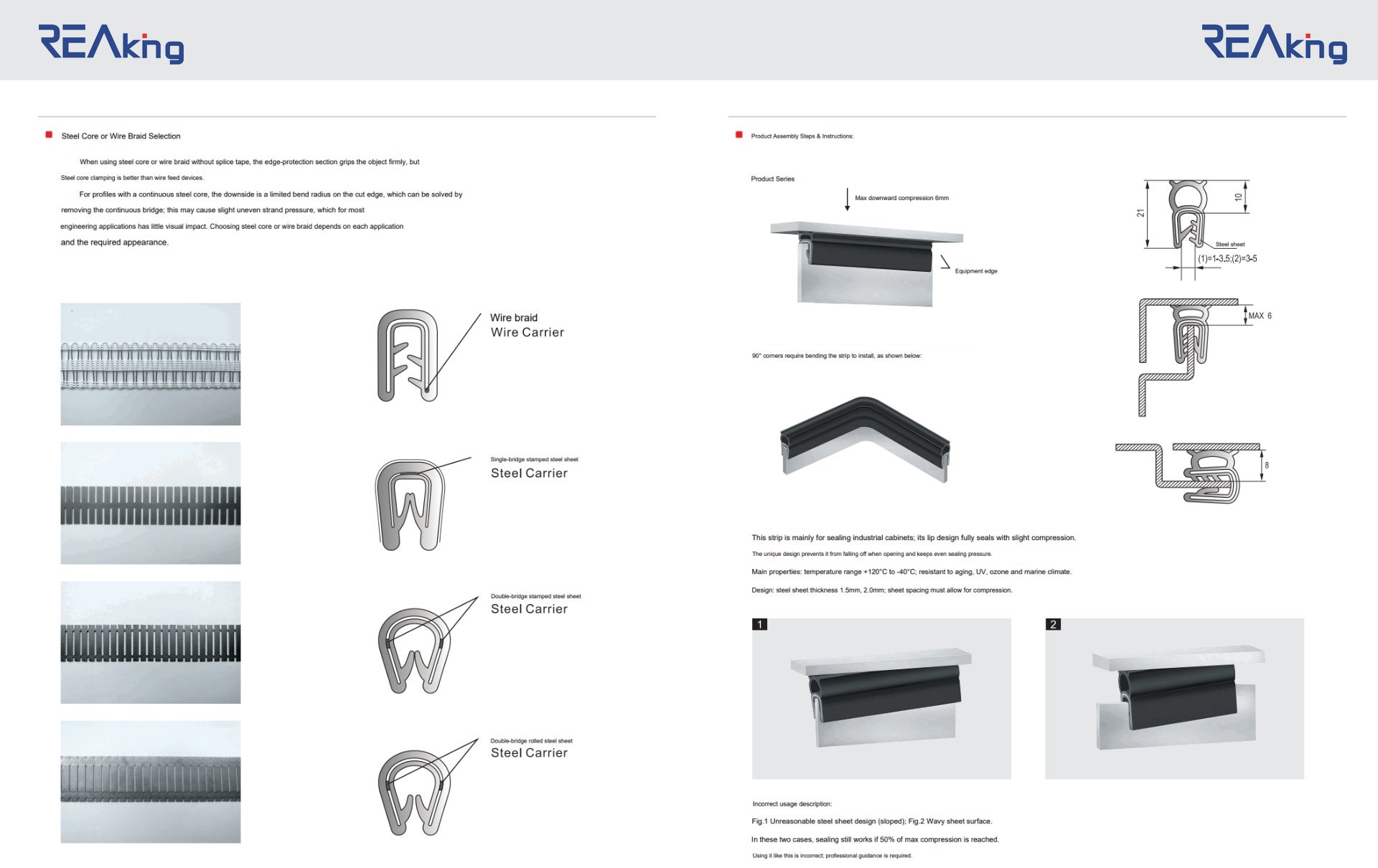
Steel Core vs Wire Braid: Side by Side
| Feature | Steel Core (Steel Carrier) | Wire Braid (Wire Carrier) |
|---|---|---|
| Carrier form | Continuous stamped steel sheet (single / double bridge) | Braided steel wire |
| Clamping | Stronger | Slightly weaker |
| Flexibility / corners | Limited bend radius; remove the bridge to bend | Good; 90° bendable |
| Shape stability | Good | Good |
| Best for | Straight, long edges and firm clamping | Irregular profiles and multi-corner, follow-shape mounting |
The Performance That Is Identical for Both
Whichever carrier you choose, the rubber compound performance is the same:
- Maximum downward compression ≈ 6 mm;
- Temperature range +120 °C to −40 °C;
- Resistant to ageing, UV, ozone and marine climate.
In other words, the sealing difference comes from the carrier’s clamping and bending behaviour — not from the rubber itself.
Installation Tips
- Without splice tape, make sure the edge-protection section grips the object firmly;
- 90° corners require the strip to be bent into place;
- Avoid poor steel sheet designs — a sloped sheet or a wavy sheet surface is incorrect. In both cases sealing still works at 50% of maximum compression, but it is not correct practice and needs professional guidance;
- Keep compression within a sensible range to avoid over-compression or leakage.
Conclusion — The Two Types Are Not Very Different
Back to the original question: steel core or wire braid, which should you choose?
The honest answer is that the two types are not very different. Both use the same rubber compound with identical temperature range, ageing and weather resistance. The only real differences are in clamping and corner bending — the steel core clamps more firmly and stays straighter, while the wire braid is more flexible and bends more easily around corners.
So unless a project has a hard requirement for extreme clamping force or complex corners, the choice mostly comes down to the customer’s usage habits and installation preference. Whichever is easier to fit and more familiar on site is the right one. It is more worth your attention to get the rubber compound, compression allowance and IP rating right. Browse our sealing strip range for profiles and specifications.
Frequently Asked Questions
What is the difference between a steel core and a wire braid sealing strip?
The carrier inside. A steel core strip uses a continuous stamped steel sheet and clamps more firmly, while a wire braid strip uses braided steel wire and bends more easily around corners. The rubber compound and weather performance are the same.
Which sealing strip clamps better?
Steel core. Steel core clamping is better than wire-feed (wire braid) devices, so a steel core strip stays more securely fixed to the panel edge.
Can a sealing strip be bent around a 90° corner?
Yes. Wire braid strips bend easily. For a steel core strip, you remove the continuous bridge at the corner so the strip can bend, at the cost of slightly uneven local strand pressure.
What temperature range do your sealing strips handle?
+120 °C to −40 °C, with good resistance to ageing, UV, ozone and marine climate.
How much can a sealing strip compress?
About 6 mm of maximum downward compression. Keep the compression within a sensible range for a reliable seal.
About Reaking
Reaking manufactures industrial cabinet hardware in Shengzhou, Zhejiang, China. Our main products include industrial cabinet locks (cylinder locks, panel locks, RV locks, plane locks, rod control locks), handles, hinges and sealing strips. We supply hardware for industrial enclosures, telecom cabinets, data center cabinets, energy storage cabinets and RV applications. We serve buyers across Europe, North America, Middle East and Southeast Asia. OEM and custom orders are welcome.
